One morning, the face in the mirror is different. Not dramatically, not all at once, but unmistakably changed. Bell’s palsy moves quickly, and by the time most patients understand what is happening, one side of the face has already gone quiet. The brow no longer lifts. The smile pulls to one side. And one eye, no matter how much effort is applied, will not fully close. That last consequence is the one that demands the most urgent attention. A cornea left exposed is a cornea at risk, and for patients whose eyelid function does not return on its own, surgery is not an upgrade; it is an answer.
Key Takeaways
- Bell’s palsy can cause incomplete eyelid closure, placing the cornea at serious risk without intervention.
- Eyelid surgery addresses both the medical and visual consequences of facial nerve paralysis.
- Multiple surgical techniques exist, each selected based on the severity and duration of the paralysis.
- Outcomes include restored eye function, improved facial symmetry, and significant psychological relief.
- Results are most predictable when care is led by a subspecialist in facial nerve reconstruction.
Understanding Bell’s Palsy and Eyelid Dysfunction
Bell’s palsy is caused by sudden inflammation of the seventh cranial nerve, producing unilateral facial weakness that can fully develop within hours. The National Institute of Neurological Disorders and Stroke identifies it as the most common cause of acute facial paralysis, affecting approximately 40,000 Americans each year.
Its most medically consequential effect is lagophthalmos: the inability to fully close the eyelid. The orbicularis oculi muscle depends entirely on facial nerve input to function. When that signal is lost, the eye loses its primary defense. Research published in peer-reviewed literature on facial nerve outcomes confirms that prolonged lagophthalmos without correction carries significant risk of corneal ulceration and permanent vision loss.
For patients uncertain how their diagnosis fits within the broader landscape of facial nerve conditions, the Facial Paralysis Institute’s clinical overview offers essential grounding.
When Surgery Is the Right Decision
Most Bell’s palsy patients recover within three to six months. For those who do not, the case for surgery is clear. Lubricating drops and moisture chambers serve a purpose in early management, but they are holding measures, not solutions. When the cornea is repeatedly exposed and conservative care can no longer keep pace with that exposure, surgical correction is not a last resort; it is the most direct path to protection.
The decision becomes straightforward once the full clinical picture is understood. What matters at that point is precision: selecting the technique that fits the patient’s anatomy, the degree of nerve recovery present, and the outcomes they are working toward.
Surgical Options: Precision Tailored to Each Patient
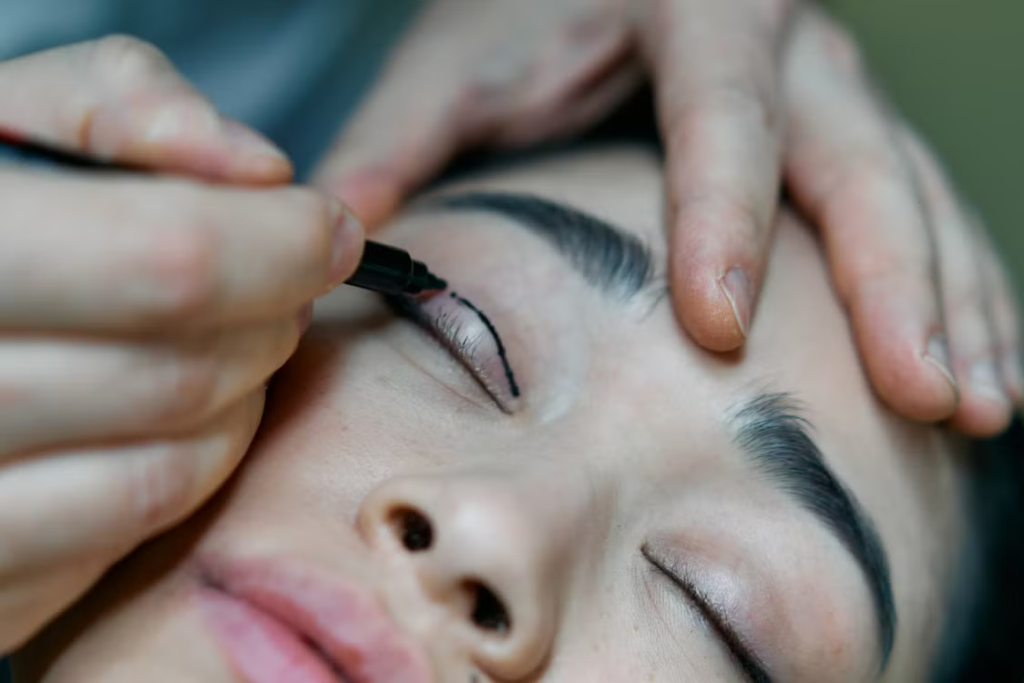
Surgical planning begins with a thorough functional evaluation. Techniques are selected individually or in combination based on where dysfunction is occurring and to what degree.
Upper Eyelid Weighting
A finely calibrated gold or platinum implant placed within the upper eyelid uses gravity to restore natural closure during blinking and sleep. It is among the most established interventions for lagophthalmos, with a reversibility profile that makes it particularly well-suited to patients still within the window of potential nerve recovery, as supported by long-term outcome data in the otolaryngology literature.
Lower Eyelid Tightening
When the lower lid loses tone and drifts away from the eye, a lateral tarsal strip procedure draws it back into position, re-establishing the seal the eye depends on to stay protected and properly lubricated.
Brow Ptosis Correction
A descended brow adds mechanical load to an already compromised upper eyelid. Lifting it through precise surgical planning reduces that weight and restores the vertical proportion the upper face relies on for both function and balance.
Canthoplasty
Tightening the outer corner of the eye improves the structural integrity of eyelid closure and refines the aesthetic line of the lid margin. It is frequently combined with other procedures for a more complete result.
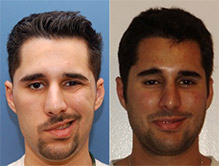
Before and After: The Moment Everything Changes
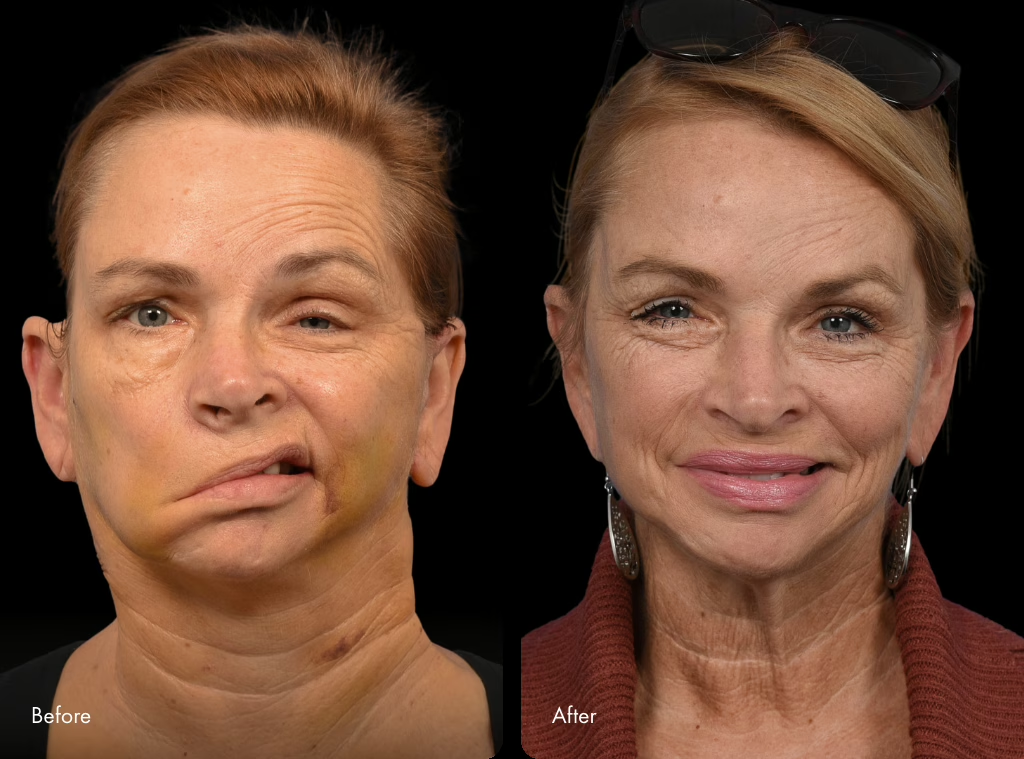
Patients often describe avoiding mirrors in the morning. Not from vanity, but because the reflection no longer corresponds to how they feel inside. The eye that will not close. The brow that descends without permission. The asymmetry that precedes every conversation and lingers after it ends. Over time, these details do not stay cosmetic; they begin to shape how a person moves through the world, how present they allow themselves to be, how much of their attention stays inward rather than outward.
After surgery, the change arrives in small but cumulative moments. The eye closes during sleep without intervention. The morning routine, once built around managing dryness and discomfort, simply stops. In conversation, patients stop watching their face and start using it. The result is not theatrical; it is the face as it was, operational, proportionate, and inhabited again.
Results from facial nerve patients, viewable at the Facial Paralysis Institute gallery, illustrate how technically precise correction restores proportion without erasing the qualities that make a face individual.
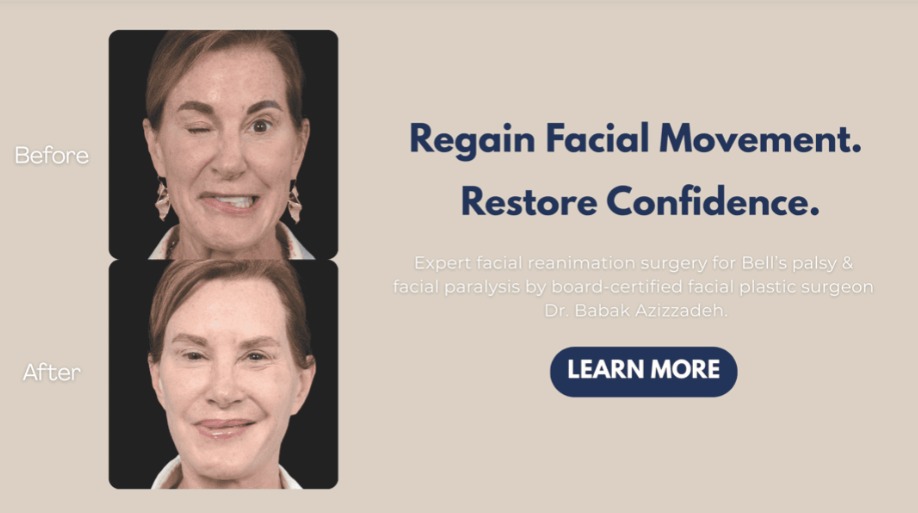
Expert Care With Dr. Babak Azizzadeh
Facial nerve reconstruction requires subspecialty precision that extends well beyond general plastic surgery training. Dr. Babak Azizzadeh brings internationally recognized expertise in facial nerve and eyelid reanimation surgery, with a clinical philosophy built on anatomical depth, individualized planning, and a clear-eyed understanding of what each patient has been through.
Every consultation involves a thorough assessment of nerve function, eyelid mechanics, and corneal health, followed by a direct conversation about what surgery can achieve and what recovery will realistically require.
Schedule a consultation to begin that conversation.
Recovery and Results
The first days after surgery tend to surprise patients. Swelling is expected, but so is something else: the eyelid closes. For many, it is the first time in months that sleep has come without tape, without waking to a dry and irritated eye, without the low-level vigilance that paralysis demands around the clock. Bruising fades through the first two weeks. The face continues to settle in the months that follow, each small refinement arriving quietly until the result simply feels like the face again, not a surgical outcome, but a return.
Identity, Restored
The clinical results matter. What happens beyond them matters just as much. Patients living with facial nerve paralysis report significantly elevated rates of anxiety, social withdrawal, and depression. The toll is not only physical; it is the gradual narrowing of how much space a person allows themselves to occupy.
What surgery returns, at its most meaningful, is not simply a closing eyelid or a more balanced face. It is the experience of being in a room without managing how you appear in it. The freedom to listen rather than monitor. The quiet but profound shift of recognizing oneself again, not as someone recovering from something, but as someone who has simply come back. That quality of return, subtle as it sounds, is what patients describe most consistently when the results have settled. And it is the outcome that defines care at this level.
Conclusion
For Bell’s palsy patients whose eyelids have not recovered, surgery is a medically grounded, precisely executed path forward. The right procedure, led by a surgeon with genuine subspecialty depth, returns what paralysis disrupted: protection, proportion, and a face that functions the way it was always meant to.
Explore the full range of available treatments and take the step toward care designed entirely around you. Request your consultation at the Facial Paralysis Institute today.
Frequently Asked Questions
Is this surgery only considered after all other options have failed? Not necessarily. When corneal exposure is ongoing and nerve recovery has plateaued, surgery is often the most appropriate first intervention, not a fallback. Waiting too long can compound the very risk the procedure is designed to prevent.
Can eyelid surgery be performed while Bell’s palsy is still in the early stages? In select cases, yes. Upper eyelid weighting is particularly well-suited to earlier intervention because it is reversible. If nerve function returns fully, the implant can be removed without affecting long-term outcomes.
What makes eyelid surgery for Bell’s palsy different from standard cosmetic eyelid surgery? The goals are fundamentally different. Standard blepharoplasty addresses aesthetic concerns in a functioning eyelid. Eyelid surgery for Bell’s palsy addresses a structural and neurological failure, restoring mechanics the nerve can no longer provide on its own.
Will the surgical result hold if nerve function partially returns over time? Yes. Most procedures are planned with partial recovery in mind. If nerve function improves after surgery, outcomes typically improve alongside it rather than conflict with it. This is part of why individualized surgical planning matters.
How does a patient know which procedure is right for them? That determination requires a hands-on clinical evaluation, not a symptom checklist. The degree of lagophthalmos, lower lid position, brow descent, and remaining nerve activity all factor into the decision. A subspecialty consultation is the only reliable starting point.
Is there a point at which surgery is no longer beneficial? Rarely. Even in longstanding paralysis, surgical correction of eyelid mechanics can meaningfully reduce corneal risk and improve daily life. The technique may shift based on how much time has passed, but the case for intervention does not disappear with it.
How do I get started? Visit facialparalysisinstitute.com to learn more and request a consultation with a facial nerve specialist.
Request your consultation with Dr. Azizzadeh today
Call us at (310) 657-2203 to schedule an appointment.
Schedule a Consultation