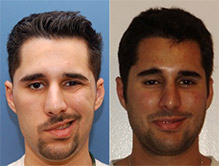
Facial synkinesis affects individuals after Ramsay Hunt Syndrome or Bell’s palsy, as well as acoustic neuroma and trauma patients who have had their facial nerve severely injured, cut, or sewn back together. Synkinesis essentially occurs anytime the facial nerve regenerates after an injury. The nerves are functioning, but the individual branches have rewired incorrectly, so the facial muscles are not moving in a coordinated manner, resulting in smile and eyelid dysfunction. Fortunately, many safe and effective synkinesis treatments are available.
How Synkinesis Develops
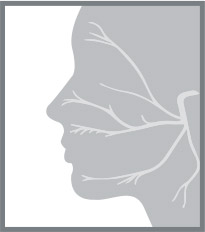
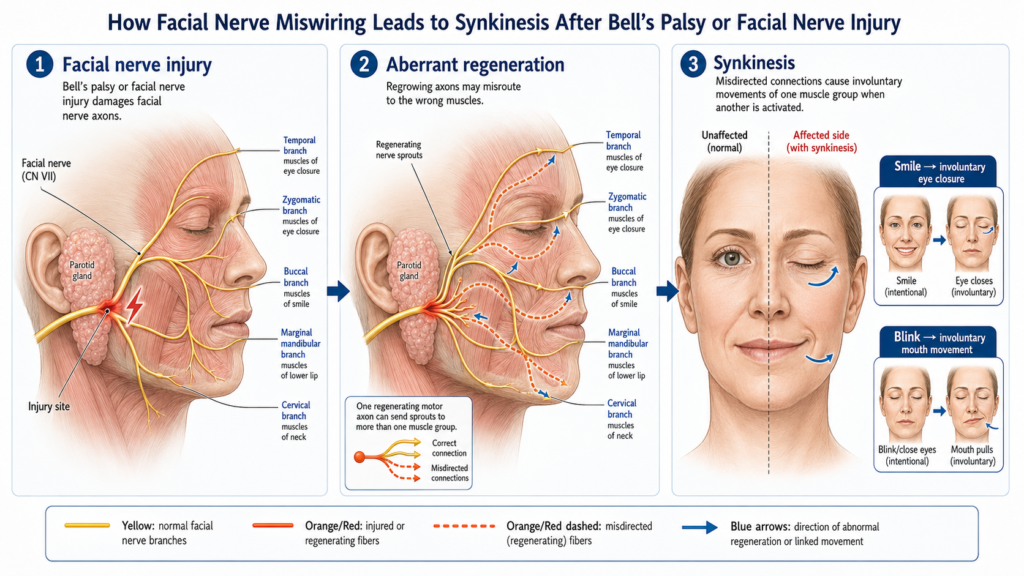
After a facial nerve injury, the nerve can regrow, but the new branches don’t always find their way back to the right muscles. One branch may split and reach two separate muscles, causing both to fire at the same time.
This abnormal rerouting, known as aberrant regeneration, is what drives the involuntary movements that define synkinesis. The condition can’t be prevented, but it can be treated effectively once diagnosed, typically starting around one year after the initial injury.
Common Signs and Symptoms
| Symptom | What You Notice |
| Eye closes when smiling | Narrowing or full closure on the affected side |
| Restricted smile | Reduced movement or asymmetry during expressions |
| Cheek and chin tightening | Muscles contract involuntarily during eye closure |
| Neck bands | Platysma muscle tenses on the affected side |
| Facial fatigue and tightness | Ongoing tension, heaviness, or cramping sensations |
How Is Synkinesis Diagnosed?
Many patients mistakenly believe their involuntary movements are merely residual weakness from conditions like Bell’s palsy or Ramsay Hunt Syndrome, delaying a proper diagnosis. A clinical evaluation, often supported by electromyography (EMG) testing to measure muscle activity, is essential to identify the abnormal co-contraction patterns that define synkinesis.
At the Facial Paralysis Institute, Dr. Babak Azizzadeh combines clinical examination with a thorough patient history to create a personalized treatment plan. Even if previous consultations were discouraging, a specialized workup can reveal effective options as soon as the facial nerve has sufficiently stabilized.
1. Selective Neurolysis: The Gold Standard for Long-Term Relief
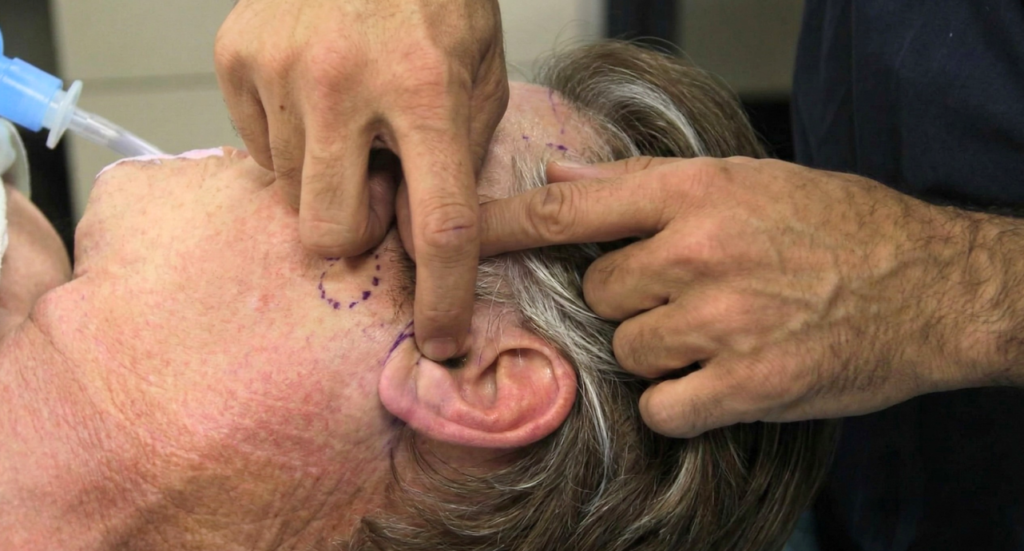
Selective neurolysis is a cutting-edge synkinesis treatment pioneered by Dr. Babak Azizzadeh, a globally recognized facial nerve surgeon who has been featured on the Oprah Winfrey and Dr. Oz Shows. During surgery, Dr. Azizzadeh selectively decreases the activity of nerves that counter the smile mechanism through a minimally invasive incision. He also releases the overactive platysma muscle, which pulls the corner of the mouth down and prevents a synkinesis patient from making an appropriate upward smile motion. This further improves the upward trajectory of the mouth and reduces synkinesis.
Since the patient’s own facial nerve and muscles are now allowed to work in a more natural way, the smile improvement is natural, emotional, and spontaneous, with no evidence of the ‘joker’ smile so often associated with poorly performed plastic surgery.
Dr. Azizzadeh developed selective neurolysis with a simple goal: to help patients improve their quality of life and non-verbal communication. It is the first long-term treatment option for synkinesis patients, and to date, other smile reanimation procedures have been unable to match its results.
For patients with more complex presentations, surgeons may also consider selective neurectomy, a related surgical approach that targets overactive nerve branches contributing to unwanted muscle contractions. The right surgical path depends on each patient’s specific pattern of synkinesis and overall facial nerve health.
To find out whether selective neurolysis is the right option for you, schedule a consultation with Dr. Azizzadeh and get a personalized assessment of your synkinesis.
Synkinesis Symptoms and Treatment
2. Botox for Synkinesis: Effective, Non-Surgical Relief
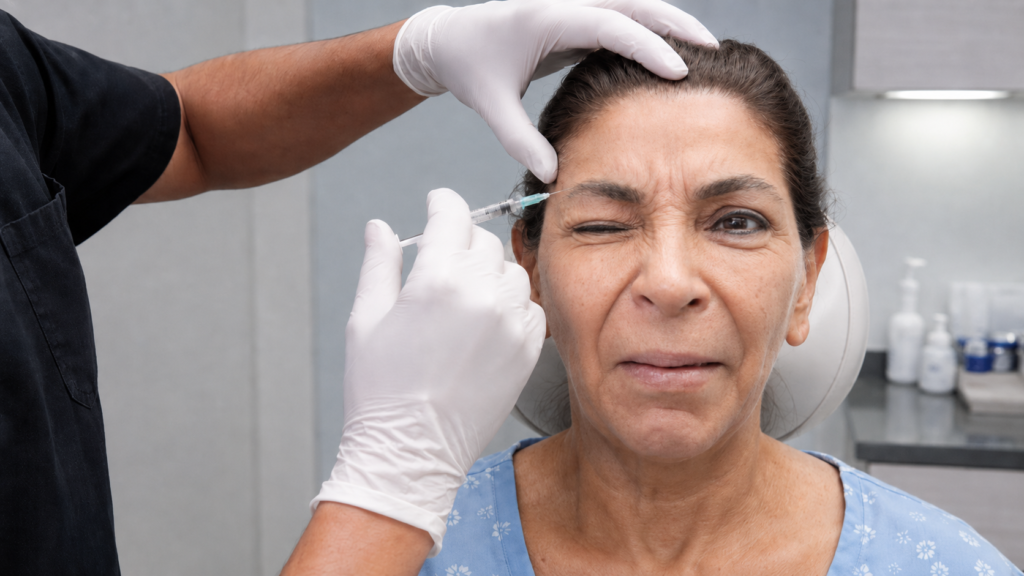
Botox reduces unwanted muscle activity and excessive tension in the muscles around the eyes, cheeks, and neck. It helps synkinesis patients create a more symmetrical overall facial appearance. Botox has also been shown to improve facial function and aesthetics for these patients.
Botox is derived from a protein found in botulinum toxin. It counteracts the effects of synkinesis by relaxing the facial muscles and preventing them from contracting. This limits unwanted muscle movements and reduces tension in areas of the face that are hyperactive.
Botox is most effective in improving eyelid narrowing associated with synkinesis, and it also works well for reducing tension in the platysma, the most superficial muscle of the neck. While botox for synkinesis offers clear benefits, results are temporary, generally lasting up to four months. Patients seeking longer-lasting outcomes may be candidates for surgery.
3. Neuromuscular Retraining: Rewiring the Brain-Muscle Connection
Neuromuscular retraining (NMR), also referred to as facial neuromuscular retraining or physical therapy, is used to treat patients dealing with a facial nerve that hasn’t healed properly or doesn’t function naturally. NMR can help synkinesis patients improve facial muscle coordination.
For example, a patient’s eyes might narrow when they try to smile. In this case, the facial muscles are strong enough to form an expression, but the wrong muscle fires out of sequence, resulting in distorted movement.
With NMR, patients learn which muscles are responsible for different expressions. They’re taught to isolate and activate the correct muscles while relaxing those that aren’t supposed to be moving. NMR can also help reduce tightness and cramping, leading to more unified, symmetrical facial expressions.
NMR can be effective on its own for some patients. For others, it works best in combination with Botox injections or selective neurolysis. It takes time and dedication, so working with an experienced occupational therapist is important for achieving the best possible outcome.
A Personalized Approach to Synkinesis Treatment at the Facial Paralysis Institute
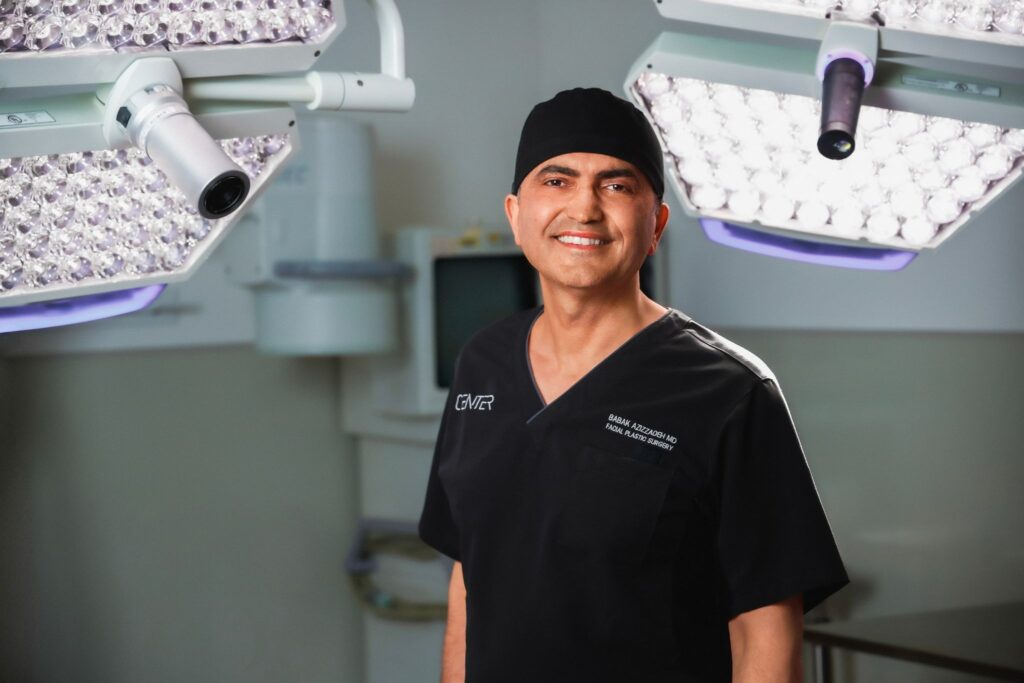
Dr. Babak Azizzadeh, a Harvard-trained leader in facial nerve medicine, takes a personalized, holistic approach to synkinesis treatment. Rather than using one-size-fits-all protocols, he evaluates each patient’s unique injury, severity, and goals to recommend the best treatment path.
Recognized globally for his development of selective neurolysis, Dr. Azizzadeh provides specialized care at the Facial Paralysis Institute, attracting patients from around the world.
What to Expect During Your Synkinesis Evaluation
Synkinesis cannot be prevented, but treatment can begin once a formal diagnosis has been made, typically about one year after the onset of facial nerve paralysis. Treatments can also be administered months or years after that initial period, which means it’s never too late to seek care. During an evaluation at the Facial Paralysis Institute, Dr. Azizzadeh will assess the extent of the condition and outline a recommended plan tailored to your needs.
- Timing: Treatment typically begins about one year after facial nerve injury
- Duration: Botox effects last up to four months; NMR is ongoing; surgical results are long-term
- Combination care: Many patients benefit from using two or three approaches together
- Follow-up: Regular monitoring helps adjust the treatment plan as the nerve continues to recover
If you’re ready to take the next step, contact the Facial Paralysis Institute to discuss your synkinesis concerns with our team and explore which treatment approach suits your situation.
Frequently Asked Questions About Synkinesis Treatment
What is synkinesis and how does it happen?
Synkinesis causes involuntary facial movements when intended ones occur. It happens when the facial nerve miswires to the wrong muscles while regenerating after an injury.
Can synkinesis be cured permanently?
Selective neurolysis is currently the longest-lasting option. Botox provides temporary relief (up to four months), and neuromuscular retraining helps improve movement patterns over time.
How long before patients see improvement?
Botox results appear within days, while neuromuscular retraining requires weeks or months of practice. Selective neurolysis results become apparent during surgical recovery.
Is selective neurolysis safe?
Yes, it is a safe, minimally invasive procedure designed to improve quality of life and restore natural facial expressions with minimal risk.
When is the right time to start treatment?
Treatment typically starts one year after the initial injury or paralysis, but it remains accessible and effective even years later.
Can synkinesis treatments be combined?
Yes. Many patients achieve the best results by combining neuromuscular retraining, Botox, and selective neurolysis based on their unique needs.
Request your consultation with Dr. Azizzadeh today
Call us at (310) 657-2203 to schedule an appointment.
Schedule a Consultation